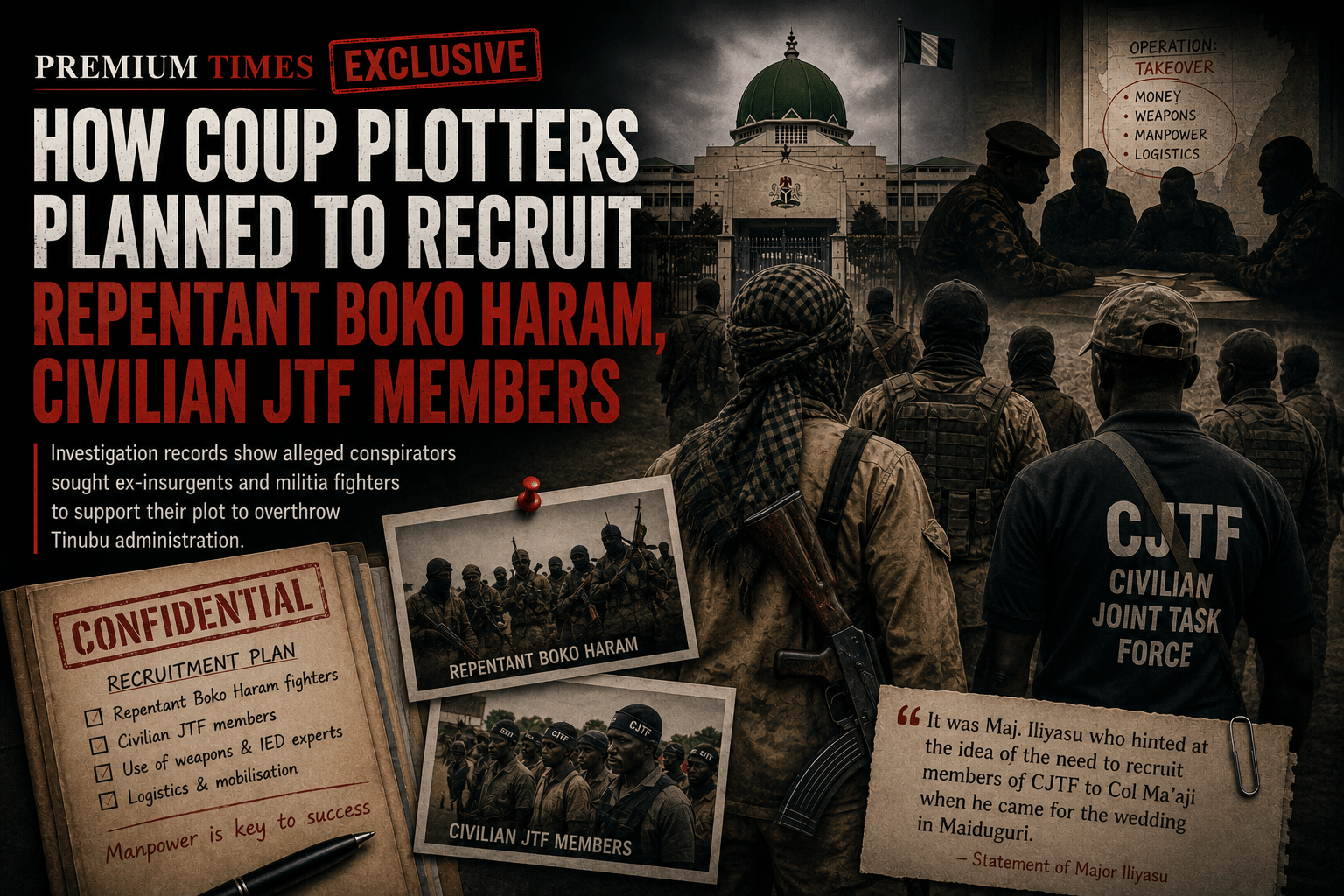
A large set of documents, including statements from senior military officers arrested for allegedly planning a coup against President Bola Tinubu, shows they intended to recruit repentant Boko Haram fighters and Civilian Joint Task Force (CJTF) members to aid their operation.
These documents, obtained by PREMIUM TIMES, contain over 7,400 pages. They include statements from civilians accused of taking part in the plot, bank account details, secret messages on encrypted apps, purchase receipts, and information on hotels used for secret meetings.
The plot was discovered in September 2025 when 16 military officers were arrested. Four months later, about 40 individuals, including a police officer and civilians allegedly involved in the plot, were also arrested.
At first, the military said the officers were detained for indiscipline and breaking service rules. Later, the Defence Headquarters confirmed they were involved in the coup plot and stated they would face prosecution.
Currently, the military officers are on trial in a General Court-Martial. Civilians, including former military officers, are being prosecuted at the Federal High Court in Abuja.
In April, the federal government filed 13 charges against six people accused of being part of the coup plot. The accused include Mohammed Ibrahim Gana, a retired major-general; Erasmus Ochegobia Victor, a retired navy captain; Ahmed Ibrahim, a police inspector; and Zekeri Umoru, an electrician at the Presidential Villa.
Others include Bukar Kashim Goni and Abdulkadir Sani, an Islamic cleric based in Zaria.
While their statements are part of the prosecution's case, their acceptance as evidence is being challenged. Some defendants told the court their statements were not given freely. This led the court to order a trial-within-trial to decide if the statements can be used as evidence in the main trial.
Plan to Recruit Boko Haram and CJTF Members
The documents show that Mohammed Ma’aji, a Nigerian Army colonel believed to be the plot leader, first heard the idea of recruiting repentant Boko Haram and CJTF members from a suspected accomplice, Jamilu Ilyasu.
The CJTF is a state-supported militia formed to help security forces in the fight against Boko Haram in the North-east. There are now 26,000 fighters in Borno State alone.
The CJTF began as a community effort against Boko Haram. At first, CJTF members used sticks, earning them the nickname “Yan Gora,” meaning “People with Sticks” in Hausa, according to the Centre for Civilians in Conflict.
Mr Ma’aji stated that the plan to move them to Abuja was not finalized. “It was Maj. Iliyasu who brought up the discussion of using repentant Boko Haram who are already using their weapons,” Mr Ma’aji said. “Before this, I did not know that repentant Boko Haram were involved in our military operations.”
Some former Boko Haram and Islamic State West Africa Province (ISWAP) fighters who surrendered have been screened and rehabilitated. They assist security forces in limited roles in the North-east.
These former fighters are often called hybrid forces by military personnel and locals. They are part of a program called the Borno Model, aimed at rehabilitating and reintegrating repentant insurgents.
In 2024, it was reported that 13 repentant Boko Haram members who fought alongside the military escaped with weapons and motorcycles provided by the Borno State government.
CJTF Recruitment Idea
“The recruitment of CJTF was Iliyasu’s idea,” Mr Ma’aji added. “When I went to the North East for a wedding, Maj. Iliyasu met me and asked how far about the movement. I complained that there was no manpower. He then said he had CJTF working for 7 Division and that we could use them.”
When questioned about plans for using Improvised Explosive Devices (IEDs), Mr Ma’aji said, “If there was any discussion of IED, it was Maj Iliyasu who said he had some Boko Haram technicians working in the theatre to make IED, but I told him that would not be necessary.”
Mr Ilyasu, a major, did not talk about his role in recruiting repentant Boko Haram fighters. But he confirmed he introduced the idea of involving CJTF members. “I was the one who hinted at the idea of the need to recruit members of CJTF to Col Ma’aji when he came for the wedding in Maiduguri,” he said.
He noted that a CJTF member named Ali was brought to work with him while in 212 Battalion. “When I went to 7 Division, he kept in touch that he needed to know where he and his boys would keep working, and I promised him I had a task for him,” Mr Ilyasu stated.
Reasons for Recruitment
The reasons behind recruiting repentant Boko Haram fighters and CJTF members are not clear. But Ma’aji and Ilyasu suggested they saw them as valuable assets because many already had firearms and combat experience.
There is no official record of how many weapons civilian volunteers in the CJTF and vigilante groups possess. However, Eric Berman, from the United Nations Institute for Disarmament Research, reported that about 25,000 firearms are with 55,000 civilian volunteers fighting Boko Haram in Borno State.
He identified the Borno State Hunters Association, the CJTF, the Kesh Kesh vigilante group, and the Vigilante Group of Nigeria as the main Volunteer Security Outfits in Borno and the North-east.
Mr Berman expressed worries about how these weapons are controlled. He noted that some members might keep some of the recovered ammunition. He estimated that around 10,000 recovered firearms were likely given to some Volunteer Security Outfit members temporarily by Borno and federal authorities.
He suggested that the army should mark firearms issued to Volunteer Security Outfits properly. He also called for the army to train these groups to help secure weapons and prevent misuse.
Meanwhile, the suspects facing charges at the General Court Martial and the Federal High Court in Abuja can challenge the use of their statements as evidence. The six men at the Federal High Court have contested not just their statements but also video clips from their interrogations, claiming improper methods were used to gather them. The prosecution wants the court to dismiss this objection, insisting all proper procedures were followed.


Drop your comment
No comments yet — be the first to drop the gist 👇