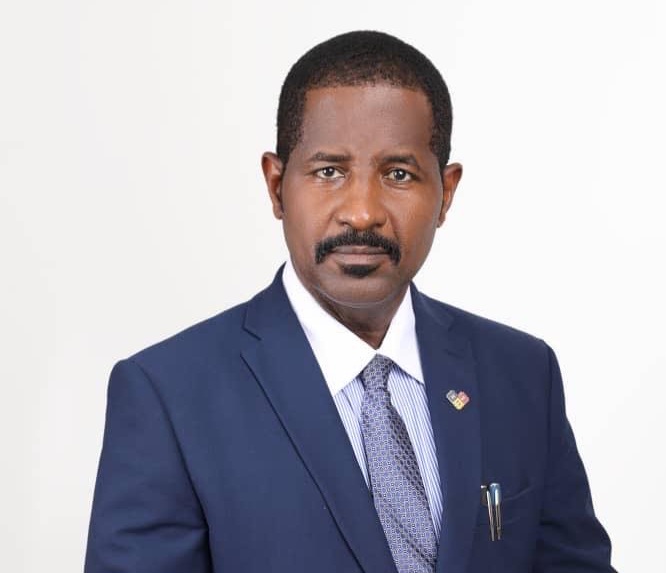
Tunis, Tunisia, As the telecommunications world gears up for the International Telecommunication Union (ITU) World Radiocommunication Conference (WRC-27) in Shanghai, China, Dr Bashir Gwandu has asked African telecom experts and spectrum managers to unite. He wants them to work together to get the 600MHz spectrum band allocated for mobile services across Africa.
While speaking at the 2026 Spectrum Management Conference in Tunis on Monday, Gwandu urged African nations to advocate for the allocation and identification of the 600MHz band for International Mobile Telecommunications (IMT). He believes that this frequency can greatly enhance affordable 4G and 5G connectivity in rural areas.
The annual Spectrum Management Conference brings together regulators, policymakers, operators, and industry stakeholders from Africa and beyond. They come to discuss ways to use spectrum better and improve telecommunications.
Gwandu, who has held key positions such as Executive Vice Chairman and Chief Executive Officer of the Nigerian Communications Commission (NCC) and Executive Vice Chairman of the National Agency for Science and Engineering Infrastructure (NASENI), said that telecom regulators and spectrum managers are in their roles to serve the public. They must ensure that rural communities are not overlooked in the digital age.
He explained that giving the 600MHz frequency band to mobile services would allow operators to cover wider areas at lower costs. He pointed out that the band can also work with other sub-1GHz spectrum resources like the 700MHz, 800MHz, and 900MHz bands to improve network capacity and user experience.
Citing the GSMA Spectrum and Rural Connectivity Report, Gwandu mentioned that rural users spend almost twice as long connected to low-band spectrum compared to urban users. He noted that having an extra 50MHz of sub-1GHz spectrum leads to a seven-percentage-point increase in 4G coverage and an 11-percentage-point increase in 5G coverage.
He added that since the 700MHz band is the main low-band spectrum for 5G deployment in many countries, the 600MHz band would be an essential resource for better rural coverage and improved service quality.
Gwandu warned that over 135 million people in rural Africa still do not have internet access. He emphasized that without enough low-band spectrum, many nations will find it hard to close the digital gap.
“Despite substantial investment in mobile infrastructure, large parts of Africa remain effectively unconnected,” he stated. “We must ask ourselves whether delays in making critical spectrum allocation decisions are contributing to the persistence of poor rural coverage.”
The telecom expert stressed that spectrum managers must maximize the social and economic value of spectrum resources for everyone, especially those in underprivileged communities. He urged policymakers to align spectrum policies with national development goals like digital inclusion, education, local content creation, cultural participation, and economic empowerment.
“Connecting the unconnected is not merely a telecommunications objective,” he said. “It is a foundation for economic growth, social inclusion, and sustainable development across Africa.” Gwandu also encouraged regulators and policymakers to make bold decisions for the public good, rather than shy away from tough policy choices.
Highlighting the importance of the UHF spectrum range, Gwandu said low-band frequencies below 1GHz are crucial for tackling connectivity issues in Africa. They can carry signals over long distances and go through buildings better.
He pointed out that these traits make low-band spectrum especially valuable for countries with many rural people, where network setup costs can be too high. “The 600MHz band remains one of the most valuable spectrum assets for the future growth of mobile broadband services, especially in areas needing extensive rural coverage,” he said.
To support his call for a primary allocation of the 600MHz band for mobile services, Gwandu referred to several ITU Radio Regulations from past World Radiocommunication Conferences. He mentioned Footnote 5.295A, which allocated parts of the 470, 694MHz band to mobile services in 42 European countries, along with Türkiye and Uzbekistan.
Similarly, Footnote 5.307B provides secondary mobile allocations in the 600MHz band for Gambia, Mauritania, Namibia, Nigeria, Senegal, Somalia, Tanzania, and Chad. Footnote 5.300 also gives allocations in parts of the band for several Middle Eastern and North African countries.
Gwandu noted that African countries pushing for a primary mobile allocation for the 600MHz band during WRC-23 faced strong opposition. Meanwhile, some Arab administrations successfully secured primary mobile allocations and IMT identification in the 614, 694MHz range through Footnote 5.307A.
He also observed that countries in ITU Regions 2 and 3 have already obtained various types of mobile allocations and IMT identifications in parts of the 470, 698MHz spectrum range. Gwandu pointed out Resolution 235 adopted at WRC-23. This resolution asks the ITU Radiocommunication Sector to study spectrum use in the 470, 694MHz band before WRC-31.
However, he mentioned that these studies currently focus only on countries listed under Footnote 5.295A, which mainly includes European nations, leaving Africa out.
As a result, many African countries, including those under Footnote 5.307B, are excluded from sharing and compatibility studies linked to Preliminary Agenda Item 2.14 of WRC-31. He urged African administrations to push for broader studies that include African countries so they can take part in discussions shaping future spectrum policies.
In closing, Gwandu called on African countries to prioritize joining Footnote 5.307A for a primary allocation and IMT identification for the 600MHz band. If that is not possible right away, he suggested aiming for inclusion under Footnote 5.307B as a temporary step while working together towards bigger regional goals.
He also encouraged African nations to work closely with their neighbors to prevent regulatory issues that could block new spectrum allocations. Gwandu called for changes to Resolution 235 (WRC-23) to extend the scope of WRC-31 Agenda Item 2.14 to African countries. This would give the continent a better chance to secure future 600MHz mobile allocations and improve affordable broadband access for rural areas.
“Africa must speak with one voice on spectrum policy,” Gwandu stated. “The decisions we make today will determine how effectively we connect the unconnected and unlock the continent’s digital future.”




Drop your comment
No comments yet — be the first to drop the gist 👇