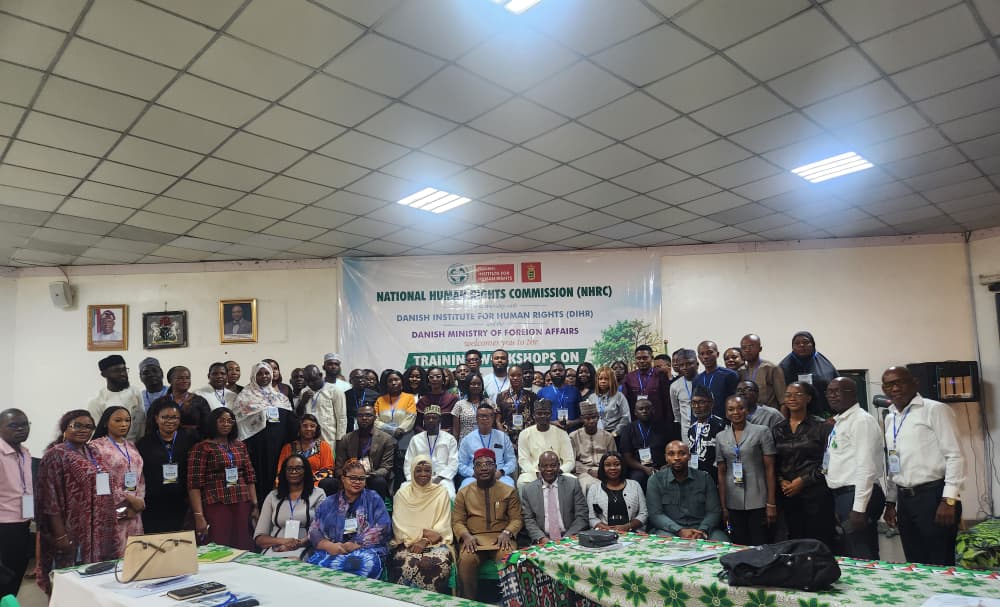
The National Human Rights Commission (NHRC) on Tuesday asked for human rights to be part of Nigeria's climate change policy.
Tony Ojukwu, the commission’s executive secretary, made this request at a workshop held by the Danish Institute of Human Rights (DIHR) and the NHRC.
“The National Policy on climate change should have human rights mainstreamed into it, because if that is not done, there is going to be a gap. The government will be working hard, but the full impact on the lives of the people will not be taken into consideration,” Mr Ojukwu said. He recommended that “the national policy of climate change must be reviewed to have human rights mainstreamed into it so that the policy will protect the life and rights of the people.”
Mr Ojukwu, a Senior Advocate of Nigeria (SAN), pointed out that the Nigerian government has focused more on cutting emissions and early warning signs. They have not really looked at how climate change affects people.
He urged the government to involve human rights experts to “see the far-reaching implications, not only the physical, but the human rights implications.” He also mentioned that the NHRC should be included in these plans.
“To have a complete approach to climate change means that human rights should be mainstreamed into government response plans and research on climate change,” he said.
Nigeria is facing changes in climate patterns with serious effects. Climate change has brought unusual rainfall, heat waves, and severe flooding that have displaced many families and ruined farmlands.
In 2025, the National Emergency Management Agency (NEMA) reported that floods affected 25 states across Nigeria. This led to the deaths of 228 people and left many others displaced.
The government has been giving warnings about extreme weather. In July, the Nigeria Hydrological Services Agency issued a seven-day flood advisory. This warned of a medium flood risk in 17 states for that month.
At the workshop, the Chief Advisor at the DIHR, Maria Poppins, said climate change has harmed development progress and the fulfillment of rights.
Ms Poppins noted that the future looks grim, especially for human rights defenders. The workshop is set to run from Tuesday to Friday at the NHRC’s head office in Abuja.
She pointed out that communities that contribute the least to emissions should have a voice in creating climate policies.
During a staff training session, Obioha Ben-Okoro, the chief legal officer of the NHRC and climate change focal person, stressed that climate change is not just an environmental problem.
Mr Ben-Okoro explained that climate change can lead to several human issues. For example, he observed that flooding caused by climate change destroys homes, ruins crops, pollutes water, disrupts schools, displaces families, and raises the risk of diseases.
These effects impact the rights to life, dignity, access to food and water, and socio-economic rights. “There will also be increased competition for scarce resources, one of the causes of the farmer-herder crisis,” Mr Ben-Okoro added.
He also stated that the dangers from climate change affect people differently, depending on their disability, socio-economic status, location, and gender.
“Climate change does not affect everyone equally; the same hazard can produce very different consequences,” Mr Ben-Okoro said.
He urged workshop participants to use a human rights approach before, during, and after climate change events.
Mr Ben-Okoro explained that this could be done through participation in decision-making, accountability, access to justice, transparency, and ensuring equality and non-discrimination.
To tackle climate change in Nigeria, the NHRC set up a National Working Committee in partnership with the Federal Ministry of Environment and the National Council on Climate Change.
Drop your comment
No comments yet — be the first to drop the gist 👇