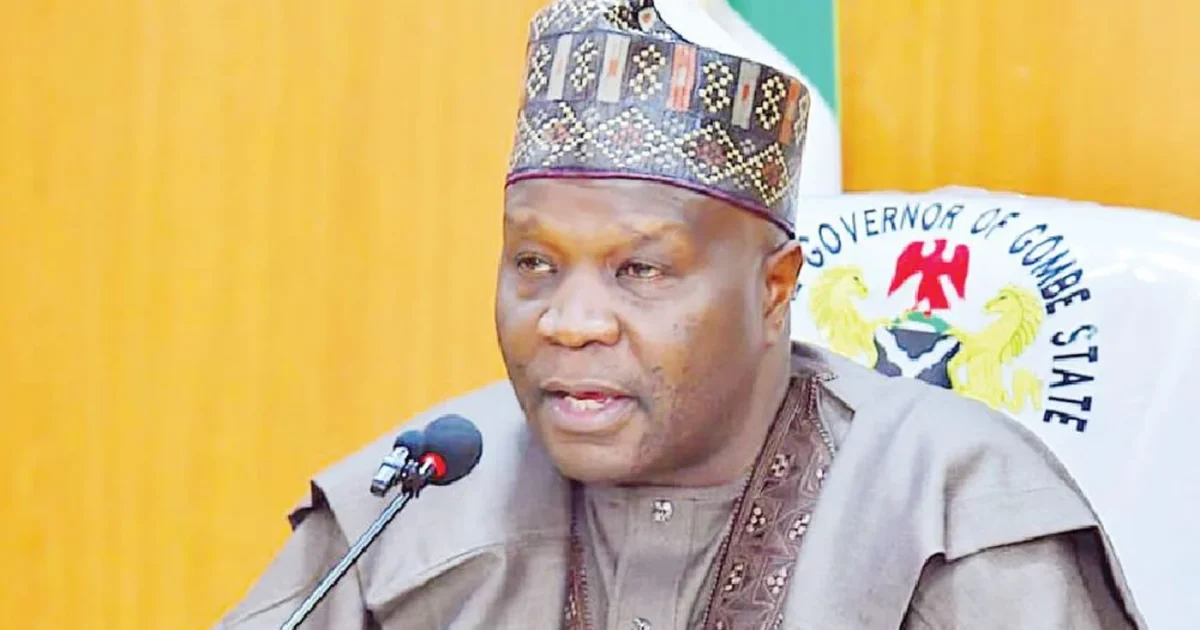
The hunt for deputy governorship candidates in Gombe has turned into more than just a legal requirement. It is now a contest involving religion, geography, loyalty, and the future political power in the state. As the APC, PDP, and ADC discuss their interests before the deadline for submitting running mates, the decisions they make could show their plans for the Gombe Government House, Chima Azubuike reports.
With the Independent National Electoral Commission opening the door for political parties to upload their governorship running mates, attention in Gombe State has moved from the governorship candidates to selecting deputy governorship candidates, a key decision in the electoral process.
For the three main candidates, picking a running mate goes beyond meeting a constitutional obligation. It requires careful political discussions with party leaders, traditional institutions, religious groups, youth organizations, and women’s groups, whose interests often come together around the choice of who will be second on the ticket.
Across the state, discussions have shifted from campaign slogans to political strategies. Behind closed doors, party leaders are balancing competence against loyalty, popularity against experience, and electoral calculations against long-standing demands for fairness and inclusion.
The race is becoming a three-way contest involving the All Progressives Congress candidate, Dr. Jamilu Isyaku Gwamna; the Peoples Democratic Party candidate, Professor Isa Ali Ibrahim Pantami; and the African Democratic Congress candidate, Bala Bello.
While smaller parties are expected to join the race, experts believe the fight for Gombe Government House will mainly focus on these three candidates. With the governorship candidates already chosen, attention is now on who will stand beside them on the ballot.
Political watchers point out that choosing deputy governors has always been important in Gombe politics. While the governor is the main candidate, the deputy often acts as a link between different political interests, assuring communities they are part of the government while also expanding the ticket’s appeal.
Like many Northern Nigerian states, Gombe’s political scene has developed around an informal balance that considers religion, geography, and inclusion. Therefore, a running mate's identity often reflects broader negotiations within and outside political parties.
This reality is more crucial in the current race.
All three leading governorship candidates are Muslims, leading many analysts to suggest that parties may look towards Gombe South, a mainly Christian area that includes Balanga, Billiri, Kaltungo, and Shongom Local Government Areas, for running mates.
There is no legal requirement for such balancing, but history shows that parties often consider religious and regional representation when forming their tickets.
For the PDP, the situation seems straightforward.
Professor Pantami, a former Minister of Communications and Digital Economy, and a well-known Islamic scholar, is expected by some analysts to choose a Christian running mate from Gombe South to widen the ticket's appeal across the state.
The challenge is not whether the deputy should come from the South, but which of the four local government areas should provide the candidate.
This question has rekindled debates about political inclusion, historical representation, and zoning.
Among the strongest arguments is the call for Shongom Local Government Area to produce a deputy governor for the first time since the return to democracy in 1999.
Political enthusiast Iliya Samuel Laro argues that historical records support this demand.
He said, “In the 27 years since Gombe State returned to democracy, one arithmetic has remained embarrassingly constant: whenever Gombe South produces the Deputy Governor, that honour has gone to only two of its four local government areas. Kaltungo had it once under a different political era. Shongom has never had it.”
Laro dismissed claims that this argument is merely sentimental.
“This is not a mere accusation. It is a record. And records cannot be argued away,” he added.
Political records show that Senator Joshua Lidani from Kaltungo served as deputy governor from 1999 to 2003 under the late Governor Abubakar Habu Hashidu. Under Governor Danjuma Goje, Dr. John Lazarus Yoriyo from Balanga was deputy governor, followed by the late David Albashi, also from Balanga, in 2011. After Albashi’s death, Tha’anda Jason Rubainu from Balanga finished the term. Governor Ibrahim Hassan Dankwambo appointed Dr. Charles Iliya from Billiri, while the current Governor Muhammadu Inuwa Yahaya has Dr. Manassah Daniel Jatau from Balanga as deputy governor.
Supporters of the Shongom argument believe these appointments show a political imbalance that needs correction.
They argue that while Balanga, Billiri, and Kaltungo have all had deputy governors, Shongom is the only local government in Gombe South that has not held the position despite its contributions and population.
Not everyone agrees with this view.
Some politicians say elections are won based on political strength, not rotational arrangements. They argue that competence, grassroots acceptance, and voting capacity should be the key factors.
This tension between fairness and electoral strategy shapes the debate around the PDP’s final choice.
Political analyst Cliff Stanley thinks the race for the PDP deputy governorship seat is still open, with several names being considered.
He said, “Markus Wina and Dr. Jeremiah Gado are the contenders so far in ADC for the deputy governorship seat.”
His comments suggest that while advocacy groups continue to push for their preferred candidates, party leaders are still considering multiple options before making a final decision.
Beyond individual personalities, Stanley believes political value should be crucial in every nomination, arguing that a running mate must strengthen the ticket rather than just fill a spot.
The calculations facing the ruling APC seem more complicated.
Unlike the PDP, where many expect a Christian running mate from Gombe South, discussions within the APC have created competing arguments.
While some members want to keep the traditional Muslim-Christian ticket that has defined much of Gombe’s democratic history, others believe that new political realities could allow for a Muslim-Muslim ticket.
Still, many party members think religious inclusion is politically beneficial in a state that has maintained peaceful interfaith relations.
Another factor influencing the APC’s decision is geography.
With the party’s state chairman coming from Kaltungo, some observers feel the deputy governorship position could go to Billiri or Shongom to avoid concentrating power in one local government area.
Others still argue in favour of Balanga.
APC chieftain Dr. Abubakar Kumo insists that electoral factors should take precedence over rotational arrangements.
“That would be a wrong political move because we have to consider the number of votes. No local government has more votes than Balanga in the South,” he said.
For Kumo, this issue goes beyond fairness; it is about political strategy.
He noted that many stakeholders already understand the existing calculations.
“Of course many of us know the permutations. It’s a known fact that the running mate has to come from Gombe South and be a Christian. But the question is, which part of the South?” he added.
Kumo explained that existing party nominations should guide the APC’s choice.
“If I were asked, I would suggest Balanga since the APC senatorial and House of Representatives candidates come from Shongom. So Kaltungo is out of the equation because they’re virtually the same with Shongom. Balanga should produce the running mate once again,” he added.
He also mentioned that one of the names being discussed within party circles is retired Rear Admiral Nuhu Jiddere, a former Deputy Chief of Defence Space Administration at the Defence Headquarters in Abuja.
As discussions heat up within the APC and PDP, the African Democratic Congress (ADC) is also facing a critical decision that could shape its success in the 2027 governorship race.
For the opposition party looking to expand its political footprint in Gombe State, choosing a running mate offers a chance to balance its ticket and set itself apart from larger parties by showing a commitment to inclusion, competence, and political renewal.
Whether the parties will focus on fairness, experience, electoral strength, or regional balance remains to be seen.
While the APC and PDP continue their discussions, the ADC is dealing with a similar political challenge but from a different angle. The party’s leaders know that their choice of a running mate could greatly affect how the public sees their readiness to govern.
Political analysts think the ADC has a chance to showcase a ticket that reflects inclusion while appealing to voters looking for a fresh political option. But like the APC and PDP, the party faces the realities of zoning, religion, grassroots influence, and internal party dynamics.
One issue already affecting discussions in the ADC is the position of the party’s state chairman, Keftin Amuga, who is from Billiri Local Government Area. While there is no formal rule against another key party figure coming from the same area, some believe the deputy governorship position should naturally go to Balanga, Kaltungo, or Shongom to broaden the party’s regional appeal.
Political analyst Cliff Stanley said the ADC could make a statement on inclusion by considering a female running mate.
“The ADC in Gombe lacks strong deputy governorship candidates. I think the only promising candidate is the woman leader, Naomi Lasara, who is more visible and from Gombe South,” he said.
Stanley’s suggestion has sparked fresh discussions about women’s roles in Gombe politics.
Although women have held positions in the National Assembly, state executive councils, local government administration, and advisory roles, the deputy governor’s office has been held only by men since Gombe State was created.
Whether any party will change that trend is uncertain.
The prominence of retired military officers, lawyers, educationists, grassroots politicians, and technocrats among the names being considered also highlights a wider feature of Gombe politics: the search for candidates who can complement the governorship ticket.
For some parties, this may mean choosing an experienced administrator. For others, it may require a grassroots politician with strong networks and cross-community appeal.
Ultimately, the decision lies with the governorship candidates and their party leadership.
Until the final announcements are made, every endorsement, political memo, and consultation will be part of a larger contest for influence.
What is clear is that the fight for deputy governorship positions has become almost as competitive as the governorship race.
The strong advocacy for personalities like Barrister I.Y. Melah, Benjamin Sati, Hon. Amos Mela Boh, Naomi Lasara, Markus Wina, Dr. Jeremiah Gado, Rear Admiral Nuhu Jiddere, Yakubu Sarma, Aliyu Kombat, and others shows how important this office has become.
For candidates and their supporters, the position represents an opportunity to influence governance and enhance representation. For the parties, it is a chance to present balanced tickets that build confidence among diverse groups of voters. For the electorate, the choices made will indicate the values, priorities, and political strategies that will shape each campaign.
As the submission deadline approaches, discussions are expected to heat up. More endorsements will come, more interest groups will express their views, and political calculations will dominate conversations in party offices, community meetings, and government circles.
Until the final names are revealed, speculation will continue to influence public discussion. But once the candidates are announced, the focus will shift from who was selected to whether the parties made the right choices.
While the deputy governorship decisions may not solely determine the outcome of the 2027 election, they will affect alliances, campaign messages, and each party’s ability to balance ambition with inclusion, strategy with fairness, and political calculations with public expectations.
In a race already shaped by changing alliances, legal battles, party defections, and renewed political engagement, the fight for Gombe’s next deputy governor has grown from a supporting role into a key storyline of the 2027 election season. The final choices may reveal as much about each party’s election strategy as the manifestos they present to voters.
Drop your comment
No comments yet — be the first to drop the gist 👇