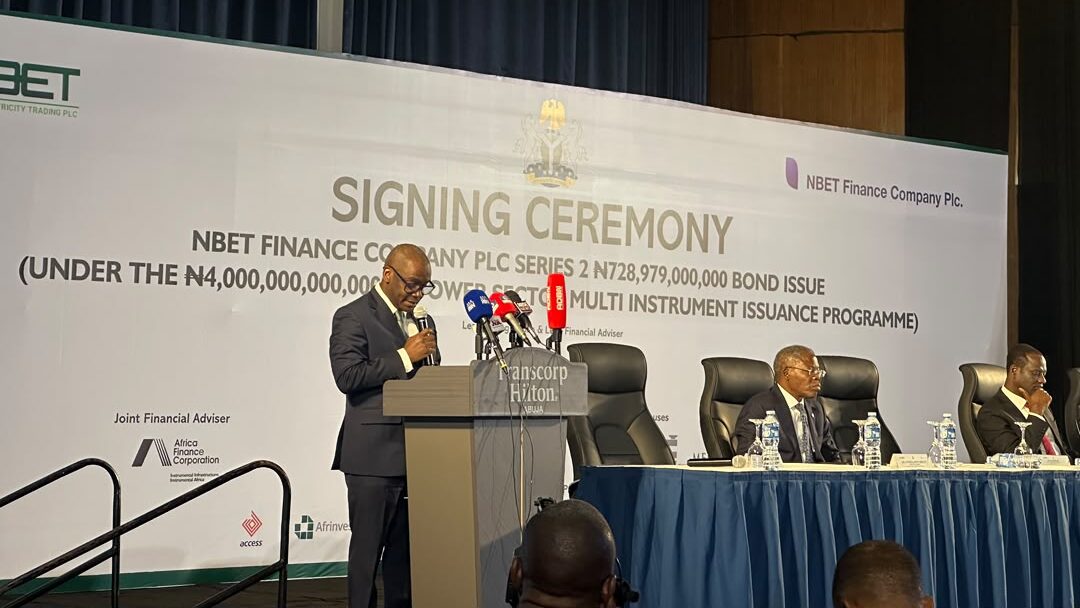
The Federal Government has raised about ₦728.9 billion through the Series 2 bond issuance under its ₦4 trillion Power Sector Multi-Instrument Issuance Programme. This is part of efforts to tackle long-standing financial issues in Nigeria’s electricity market.
The latest bond sale brings the total amount raised under the programme to over ₦1.1 trillion. This information came from government officials at the signing ceremony at Transcorp in Abuja on Monday.
The Series 2 transaction includes ₦402 billion in cash bonds raised from the capital market and ₦326.979 billion in non-cash bonds given to participating electricity generation companies (GenCos).
At the event, Akin Odeyemi, the Managing Director and Chief Executive Officer of the Nigerian Bulk Electricity Trading (NBET), said this transaction marks another step in the government's efforts to solve financial problems in the electricity supply industry.
He mentioned that the Series 2 issuance started in August 2026 and included 11 generation companies. This is an increase from the eight companies that took part in Series 1.
"The Series 2 issue has an aggregate value of approximately ₦729 billion and will be done in two parts, Tranche A and B," Mr Odeyemi said.
He added that the increased participation shows growing trust among stakeholders in the programme as a way to tackle confirmed debts in the power sector.
Debt reduction
The Federal Government set up the ₦4 trillion Power Sector Debt Reduction Programme to pay off verified legacy debts owed to generation companies and other stakeholders. The aim is to restore liquidity and investor trust in the electricity market.
Series 1 of the programme was completed in January 2026, raising ₦501 billion with the participation of eight generation companies.
Olu Verheijen, the Special Adviser to the President on Energy, was represented by her office's team lead. She said Series 1 proved the programme's effectiveness, while Series 2 aims to expand the intervention.
"Series 1 proved the model, and Series 2 is scaling it up," Ms Verheijen said.
She noted that the government has signed settlement agreements with 11 generation companies that represent 21 power plants.
According to her, the programme is meant to address over ten years of unpaid and unverified debts to generation companies and gas suppliers.
She said the Federal Executive Council has approved issuing up to ₦4 trillion in government-backed bonds to pay verified debts.
Ms Verheijen described this intervention as the largest of its kind in the power sector in over ten years.
'Bond alone cannot solve power sector problems'
Taiwo Oyedele, the Minister of Finance and Coordinating Minister of the Economy, said the bond programme is just one part of the larger reforms needed to restore financial health to Nigeria’s electricity market.
He explained that the old debts have hurt liquidity, limited investment, and lowered confidence throughout the electricity value chain.
"The Federal Government’s aim is to resolve genuine legacy debts in a clear way while making reforms to stop them from happening again," Mr Oyedele said.
He pointed out that the bond programme needs to be supported by better market discipline, improved revenue assurance, and reduced losses in the system. This includes greater efficiency and accountability in the electricity sector.
He stated that the real measure of the programme’s success will not be how many bonds are issued but whether it leads to a financially sound electricity market that can attract investment and deliver reliable electricity to homes and businesses.
"This shows how the government can use the right market tools to tackle big economic issues while developing our financial markets and attracting long-term local capital," he said.
Mr Oyedele praised NBET, participating generation companies, investors, advisers, regulators, and others involved in the transaction.
The government targets more reliable electricity
Mahmuda Mamman, the Permanent Secretary in the Ministry of Power, represented the Minister of Power, Joseph Tegbe. He said the bond issuance shows the Federal Government’s commitment to fixing the structural problems in the electricity industry.
He mentioned that this initiative is part of efforts to create a stable electricity supply and support sustainable development.
Mr Mamman congratulated NBET and other stakeholders involved in the transaction, saying this move will help set the stage for a more stable power sector.
Ms Verheijen stated that the government’s larger goal is to move the electricity sector from debt and disarray to efficiency and accountability.
She believes this intervention, along with other power sector reforms, will attract new investments and ultimately improve electricity supply.
"The final benefit of what we are doing here will touch millions of homes, offices, and industries across Nigeria, who will enjoy more reliable electricity because of this bond programme and related reforms," she said.
She added that this bond programme will be an important part of the government's efforts to reshape Nigeria’s power sector.
Mr Odeyemi said NBET will keep working with government bodies, financial institutions, generation companies, and other stakeholders to find sustainable financial solutions for the sector.
He stated that the goal is to restore liquidity, financial health, and trust in Nigeria’s electricity market.

Drop your comment
No comments yet — be the first to drop the gist 👇